Open vs Closed Rhinoplasty: Which Technique Is Better for You?
Introduction
Rhinoplasty, commonly known as a nose reshaping surgery, is one of the most popular cosmetic and functional procedures worldwide. Whether you’re looking to improve the appearance of your nose, correct breathing issues, or repair damage from an injury, choosing the right surgical approach is an important part of the process.
The two primary rhinoplasty techniques are Open Rhinoplasty and Closed Rhinoplasty. While both methods aim to achieve natural, balanced, and functional results, they differ in surgical approach, recovery, and suitability for different cases.
In this blog, we’ll compare both techniques to help you understand which option may be best for your unique needs.
What Is Rhinoplasty?
Rhinoplasty is a surgical procedure that changes the shape, size, or structure of the nose. It can be performed for:
- Cosmetic enhancement
- Correcting a deviated septum
- Improving breathing problems
- Repairing trauma or injury
- Revising previous rhinoplasty results
- Correcting congenital nasal deformities
The choice between open and closed rhinoplasty depends on your anatomy, goals, and the complexity of the surgery.
What Is Open Rhinoplasty?
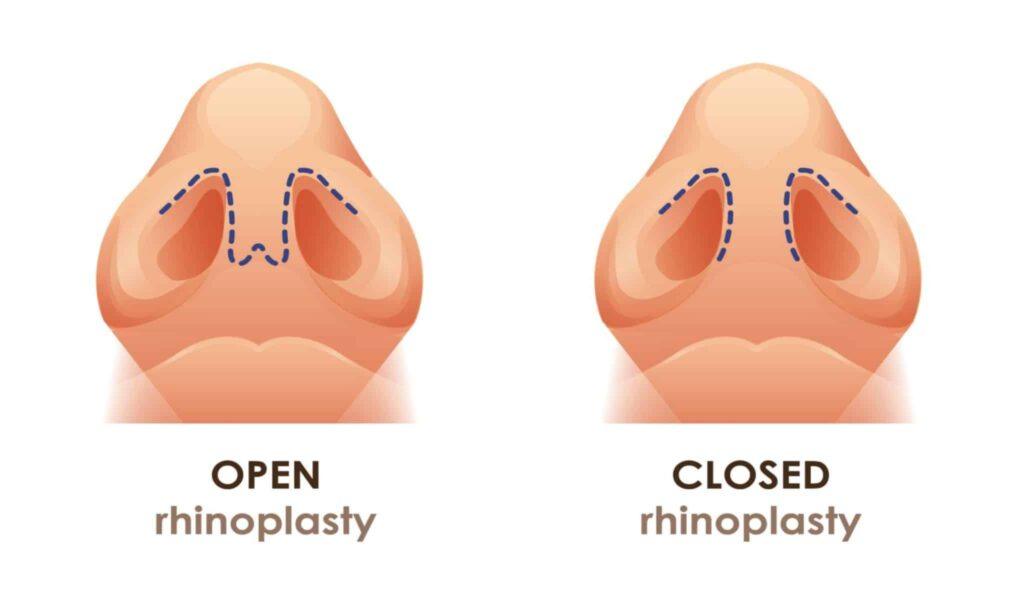
Open rhinoplasty involves making a small incision across the columella (the strip of tissue between the nostrils). This allows the surgeon to gently lift the nasal skin, providing a complete view of the underlying cartilage and bone.
Advantages of Open Rhinoplasty
Better Visibility
The surgeon has a clear and direct view of the nasal structures, allowing for greater precision.
Ideal for Complex Cases
Open rhinoplasty is preferred for:
- Major nose reshaping
- Crooked noses
- Revision rhinoplasty
- Significant asymmetry
- Complex reconstructive procedures
Greater Surgical Precision
Detailed modifications can be performed with improved accuracy.
Improved Structural Support
Useful when extensive cartilage grafting or reconstruction is required.
Disadvantages of Open Rhinoplasty
- Small external scar (usually fades over time)
- Slightly longer recovery period
- More postoperative swelling, especially at the nasal tip
What Is Closed Rhinoplasty?
In closed rhinoplasty, all incisions are made inside the nostrils, leaving no visible external scar.
The surgeon performs the procedure through these internal incisions without lifting the nasal skin completely.
Advantages of Closed Rhinoplasty
No Visible Scar
Since all incisions are inside the nose, there are no external scars.
Faster Recovery
Patients generally experience:
- Less swelling
- Reduced bruising
- Quicker healing
Shorter Surgery Time
Closed procedures often require less operating time.
Less Tissue Disruption
The nasal tissues remain more intact, which may reduce postoperative discomfort.
Disadvantages of Closed Rhinoplasty
- Limited visibility for the surgeon
- Not ideal for complicated nasal deformities
- May not be suitable for revision surgeries
- Less flexibility for extensive structural modifications
Open vs Closed Rhinoplasty: Side-by-Side Comparison
| Feature | Open Rhinoplasty | Closed Rhinoplasty |
|---|---|---|
| Incisions | External + Internal | Internal Only |
| Visible Scar | Small, usually fades | None |
| Surgical Visibility | Excellent | Limited |
| Best For | Complex surgeries | Simple cosmetic changes |
| Recovery Time | Slightly Longer | Faster |
| Swelling | More | Less |
| Revision Cases | Excellent | Limited |
| Surgical Precision | High | Moderate |
Which Technique Is Better?
There is no universal “better” technique.
The ideal approach depends on:
Open Rhinoplasty May Be Better If You Need:
- Major reshaping
- Significant asymmetry correction
- Crooked nose correction
- Revision rhinoplasty
- Trauma reconstruction
- Complex structural changes
Closed Rhinoplasty May Be Better If You Need:
- Minor cosmetic improvements
- Small dorsal hump removal
- Slight tip refinement
- Faster recovery
- No external scar
Recovery: What to Expect
Open Rhinoplasty
- Initial recovery: 10–14 days
- Swelling improves over several weeks
- Final results may take 12–18 months
- Tip swelling lasts longer
Closed Rhinoplasty
- Recovery often feels quicker
- Less postoperative swelling
- Most patients return to routine activities within 1–2 weeks
- Final results typically appear within 6–12 months
Are the Results Different?
When performed by an experienced plastic surgeon, both techniques can deliver excellent, natural-looking results.
The outcome depends far more on:
- Surgeon expertise
- Surgical planning
- Individual anatomy
- Healing response
Rather than choosing a technique yourself, it’s best to choose a qualified surgeon who will recommend the most appropriate approach for your specific case.
Is Rhinoplasty Painful?
Most patients report only mild discomfort rather than severe pain.
Common temporary symptoms include:
- Nasal congestion
- Mild swelling
- Bruising around the eyes
- Tenderness
- Temporary difficulty breathing through the nose
These symptoms typically improve significantly within the first two weeks.
Frequently Asked Questions
Will open rhinoplasty leave a noticeable scar?
The incision is very small and placed on the columella. In most patients, it heals extremely well and becomes barely noticeable over time.
Is closed rhinoplasty safer?
Both techniques are considered safe when performed by a qualified plastic surgeon. The safety depends more on surgical expertise than on the technique itself.
Which procedure has a faster recovery?
Closed rhinoplasty generally offers a slightly faster recovery with less swelling.
Can revision rhinoplasty be done using the closed technique?
Most revision rhinoplasty procedures are performed using the open approach because it provides better visibility and access to the nasal structures.
Final Thoughts
Both open and closed rhinoplasty are highly effective surgical techniques with distinct advantages. Open rhinoplasty provides exceptional visibility and precision, making it ideal for complex or revision cases. Closed rhinoplasty, on the other hand, is well suited for less extensive cosmetic changes and offers the benefits of no visible scar and a potentially quicker recovery.
The best technique is not determined by preference alone but by your nasal anatomy, aesthetic goals, and the complexity of the changes required. A consultation with an experienced plastic surgeon is the best way to determine the most suitable approach for achieving safe, functional, and natural-looking results.